Is Another an Adverb Is Again an Adjective
Types of Adverbs: The Main Kinds Explained
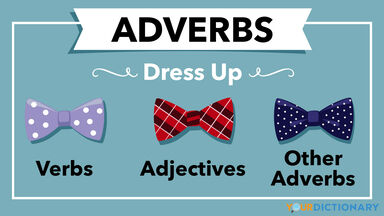
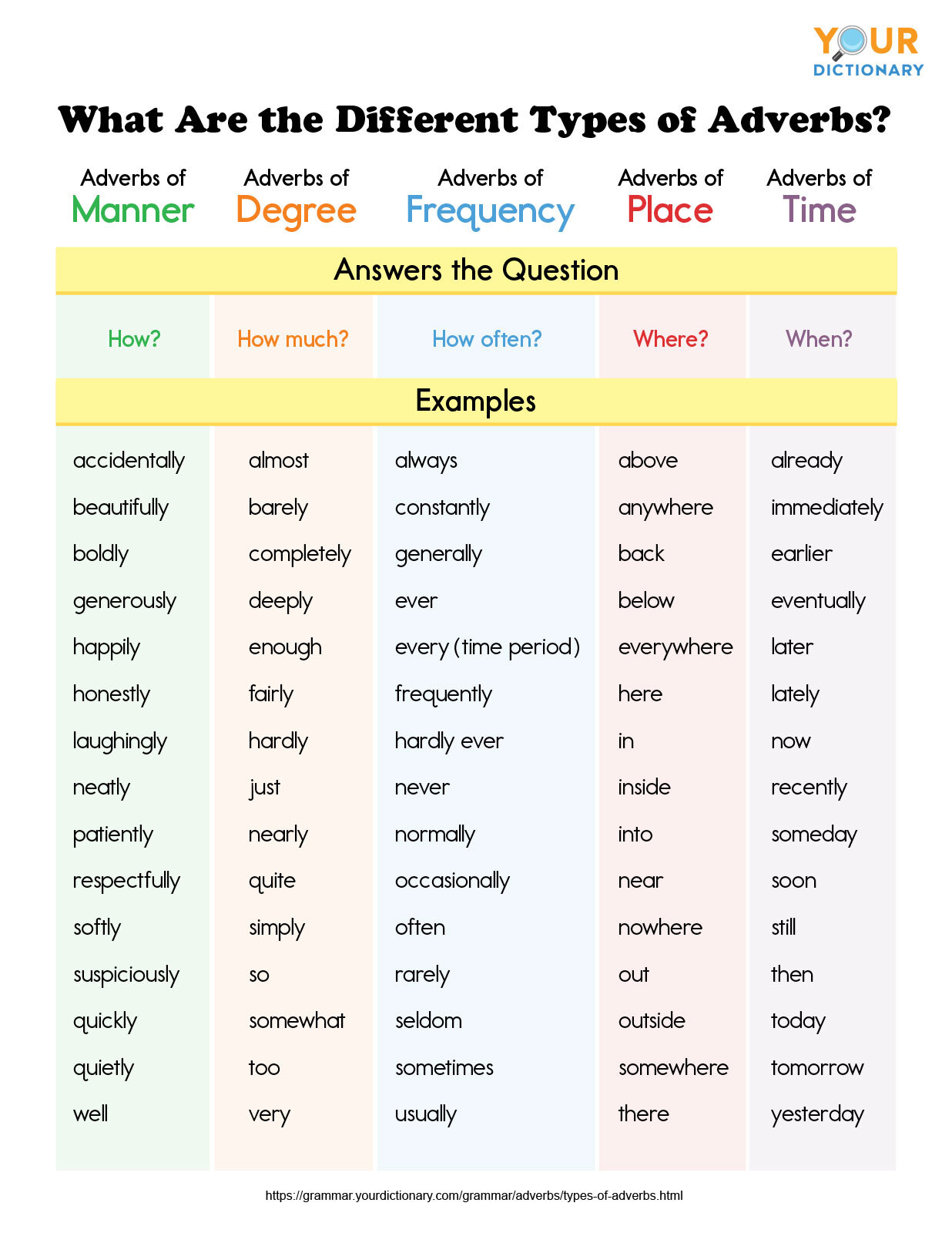
Adverbs dress up verbs, adjectives or other adverbs. Since verbs are such integral parts of our everyday language, their modifiers are also multi-faceted. To beginning, at that place are five types of adverbs you should familiarize yourself with: adverbs of degree, frequency, manner, place, and time. With these categories under your belt, yous'll be well-positioned to place all the different types of adverbs.
 adverbs dress upwardly verbs adjectives other adverbs
Adverbs of Fashion
Adverbs of manner tell us how, or in what manner, something was carried out. They mostly modify verbs and tin can often be constitute at the stop of a clause or right earlier the give-and-take they modify. This category comprises the most common adverbs — the ones that finish in -ly.
Here are some examples of adverbs of manner:
- beautifully
- generously
- happily
- neatly
- patiently
- softly
- quickly
- well
Example sentences that include these types of adverbs include:
- He trimmed the white roses neatly. (How did he trim them?)
- I combed my dog's fur carefully because it had lots of tangles. (How did you rummage it?)
- Please discuss the topic calmly. (How should I discuss it?)
- An anonymous donor generously gave us enough coin for the new phase. (How did they give the money?)
- The little girl skipped happily down the road. (How did she skip?)
Adverbs of Degree
Adverbs of degree tell us more about the intensity of the verb in the sentence. They depict how much, or to what caste, something happened. Adverbs of caste are often placed before the word they modify, although in some cases, they follow the discussion (such as the adverb "enough").
Popular adverbs of degree include:
- almost
- enough
- hardly
- just
- near
- quite
- simply
- then
- besides
Read these sample sentences to run across how adverbs of degree provide more information about the words they modify.
- This brusk essay is hardly sufficient. (How sufficient is it?)
- The wearing apparel is but gorgeous. (How gorgeous is it?)
- I'thou so excited to move to Ireland. (How excited are you?)
- Tori lost almost all her savings. (How much of her savings did she lose?)
- The book was interesting plenty to go along my attention. (How interesting was information technology?)
Adverbs of Frequency
Adverbs of frequency let us know how often something occurs. These adverbs tend to appear right before the main verb in the judgement or at the cease of the clause. Popular adverbs in this category include:
- again
- e'er
- every (hr, day, week, year, and and then on)
- never
- normally
- rarely
- seldom
- sometimes
- normally
Sentences with these types of adverbs include:
- I always read a book before bed. (How ofttimes exercise y'all read a book earlier bed?)
- He normally walks his dog at this time. (How often does he walk his canis familiaris at this fourth dimension?)
- She normally shops at the Korean market in town. (How ofttimes does she store there?)
- We never stay up past ten o'clock. (How ofttimes do you stay upwardly that belatedly?)
- I'd honey to visit Denmark once more. (How frequently would you like to visit?)
Adverbs of Place
Adverbs of place tell u.s. more nigh where the verb took identify. Many writers confuse them with prepositions, which describe the location of nouns. While some of these words can function every bit prepositions, they are considered adverbs when they alter verbs. Also, prepositions are followed by objects, while adverbs of place are non.
Mutual adverbs of place include:
- higher up
- anywhere
- back
- below
- everywhere
- here
- inside
- nowhere
- out
- outside
- in that location
Let's take a look at them in action:
- In Ireland, there are thatched-roof cottages everywhere. (Where are the cottages?)
- There are more boxes over in that location. (Where are at that place more boxes?)
- Information technology's time for tiffin, and so get inside. (Where should I get?)
- Yous can park anywhere. (Where can I park?)
- Let's go back earlier we get lost. (Where should we go?)
Adverbs of Time
Adverbs of time detail when the verb took place. We usually see these kinds of adverbs placed at the beginning or end of a sentence. Although many prepositions can also point when something happened, they are always followed by objects, so you can easily tell when a word is an adverb.
Adverbs of fourth dimension include:
- already
- earlier
- immediately
- lately
- subsequently
- at present
- recently
- soon
- tomorrow
- yesterday
You tin use adverbs of time in the following sentences:
- Lately, you've been rude to everyone around. (When were you rude?)
- They recently relocated to Santa Fe. (When did they relocate?)
- The morning newspaper arrives earlier. (When does it arrive?)
- We'll have a trip to Yosemite later. (When will we have a trip?)
- I'll finish my project tomorrow. (When volition you finish it?)
Types of Adverb Printable
If you'd like a handy reference sheet with each type of adverb, download and impress the PDF below. It'south a helpful resource for your writing notebook or classroom.
View & Download PDF
Add Adverbs
At present that yous know the different types of adverbs, feel free to add them to your writing — merely do so sparingly. If y'all encounter a spot where you can opt for 1 strong verb in lieu of an adverb and a mediocre verb, opt for the atypical verb. Otherwise, your writing tin go likewise bulky and cumbersome. If you're looking for the perfect adverb, see if you can discover it with a printable list of 100 adverbs.
Source: https://grammar.yourdictionary.com/grammar/adverbs/types-of-adverbs.html
0 Response to "Is Another an Adverb Is Again an Adjective"
Postar um comentário