Art Making Encompasses a Variety of Techniques Developed to Create Multiple Copies of a Single Image


Printmaking is the procedure of creating artworks by printing, normally on newspaper, but also on fabric, forest, metal, and other surfaces. "Traditional printmaking" normally covers just the process of creating prints using a hand processed technique, rather than a photographic reproduction of a visual artwork which would be printed using an electronic machine (a printer); even so, in that location is some cross-over between traditional and digital printmaking, including risograph. Except in the case of monotyping, all printmaking processes accept the chapters to produce identical multiples of the same artwork, which is called a print. Each print produced is considered an "original" work of art, and is correctly referred to every bit an "impression", not a "copy" (that means a different print copying the first, mutual in early printmaking). However, impressions can vary considerably, whether intentionally or not. Master printmakers are technicians who are capable of press identical "impressions" past hand. Historically, many printed images were created as a preparatory study, such equally a drawing. A print that copies some other work of art, specially a painting, is known as a "reproductive print".
Prints are created by transferring ink from a matrix to a sheet of paper or other material, by a variety of techniques. Mutual types of matrices include: metal etching plates, usually copper or zinc, or polymer plates and other thicker plastic sheets for engraving or etching; rock, aluminum, or polymer for lithography; blocks of wood for woodcuts and wood engravings; and linoleum for linocuts. Screens made of silk or synthetic fabrics are used for the screen printing procedure. Other types of matrix substrates and related processes are discussed beneath.
Multiple impressions printed from the same matrix class an edition. Since the tardily 19th century, artists have more often than not signed private impressions from an edition and oft number the impressions to course a limited edition; the matrix is and then destroyed so that no more prints can be produced. Prints may also exist printed in book form, such as illustrated books or creative person'southward books.
Techniques [edit]
| External video | |
|---|---|
 Printmaking: Woodcuts and Engravings, Smarthistory Printmaking: Woodcuts and Engravings, Smarthistory |
Overview [edit]
Printmaking techniques are more often than not divided into the following bones categories:
- Relief, where ink is applied to the original surface of the matrix, while carved or displaced grooves are absent-minded of ink. Relief techniques include woodcut or woodblock, wood engraving, linocut and metalcut.
- Intaglio, where ink is forced into grooves or cavities in the surface of the matrix. Intaglio techniques include collagraphy, engraving, carving, mezzotint, aquatint.
- Planographic, where the matrix retains its original surface, only is specially prepared and/or inked to allow for the transfer of the prototype. Planographic techniques include lithography, monotyping, and digital techniques.
- Stencil, where ink or paint is pressed through a prepared screen, including screen press, risograph, and pochoir.
A type of printmaking outside of this group is viscosity printing. Contemporary printmaking may include digital printing, photographic mediums, or a combination of digital, photographic, and traditional processes.
Many of these techniques can also exist combined, particularly within the aforementioned family. For example, Rembrandt's prints are ordinarily referred to as "etchings" for convenience, but very ofttimes include work in engraving and drypoint as well, and sometimes have no etching at all.
Woodcut [edit]

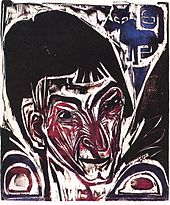
Woodcut, a blazon of relief print, is the earliest printmaking technique. It was probably outset developed equally a means of printing patterns on cloth, and by the 5th century was used in Cathay for printing text and images on paper.[ citation needed ] Woodcuts of images on paper developed around 1400 in Japan, and slightly later in Europe.[ citation needed ] These are the 2 areas where woodcut has been most extensively used purely every bit a process for making images without text.[ citation needed ]

Woodcuts of Stanislaw Raczynski (1903–1982)
The artist either draws a pattern direct on a plank of wood, or transfers an drawing done on newspaper to a plank of wood. Traditionally, the artist then handed the piece of work to a technician, who and then uses sharp etching tools to cleave abroad the parts of the block that will not receive ink.[ citation needed ] In the Western tradition, the surface of the block is then inked with the utilise of a brayer; however in the Japanese tradition, woodblocks were inked with a brush.[one] Then a sheet of paper, perhaps slightly damp, is placed over the block. The cake is so rubbed with a baren or spoon, or is run through a press press. If the impress is in color, split up blocks can be used for each color, or a technique called reduction press can be used.
Reduction printing is a name used to depict the process of using one block to print several layers of colour on ane print. Both woodcuts and linocuts tin can employ reduction printing. This usually involves cut a small amount of the block abroad, and so printing the block many times over on unlike sheets before washing the block, cutting more away and press the next color on top. This allows the previous color to evidence through. This process can be repeated many times over. The advantages of this procedure is that only one block is needed, and that different components of an intricate design volition line upward perfectly. The disadvantage is that once the creative person moves on to the next layer, no more prints can be made.
Some other variation of woodcut printmaking is the cukil technique, made famous by the Taring Padi underground customs in Java, Indonesia. Taring Padi Posters usually resemble intricately printed cartoon posters embedded with political messages. Images—usually resembling a visually circuitous scenario—are carved unto a wooden surface called cukilan, then smothered with printer's ink earlier pressing it unto media such as newspaper or sail.
Engraving [edit]

The procedure was developed in Frg in the 1430s from the engraving used by goldsmiths to decorate metalwork. Engravers use a hardened steel tool chosen a burin to cut the design into the surface of a metallic plate, traditionally made of copper. Engraving using a burin is mostly a difficult skill to learn.
Gravers come in a diverseness of shapes and sizes that yield unlike line types. The burin produces a unique and recognizable quality of line that is characterized by its steady, deliberate advent and clean edges. Other tools such equally mezzotint rockers, roulettes (a tool with a fine-toothed bicycle) and burnishers (a tool used for making an object polish or shiny by rubbing) are used for texturing effects.
To make a print, the engraved plate is inked all over, then the ink is wiped off the surface, leaving only ink in the engraved lines. The plate is and so put through a high-force per unit area press press together with a sheet of paper (often moistened to soften it). The paper picks up the ink from the engraved lines, making a print. The process can be repeated many times; typically several hundred impressions (copies) could be printed before the press plate shows much sign of article of clothing, except when drypoint, which gives much shallower lines, is used.
In the 20th century, true engraving was revived as a serious art class past artists including Stanley William Hayter whose Atelier 17 in Paris and New York Metropolis became the magnet for such artists every bit Pablo Picasso, Alberto Giacometti, Mauricio Lasansky and Joan Miró.
Etching [edit]

Albrecht Dürer, Saint Jerome in his Study, 1514.
Artists using this technique include
Albrecht Dürer, Rembrandt, Francisco Goya, Wenceslaus Hollar, Whistler, Otto Dix, James Ensor, Edward Hopper, Käthe Kollwitz, Pablo Picasso, Cy Twombly, Lucas van Leyden
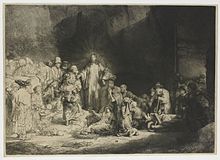
Etching is office of the intaglio family. In pure etching, a metal plate (usually copper, zinc, or steel) is covered with a waxy or acrylic ground. The artist then draws through the footing with a pointed carving needle, exposing the metal. The plate is then etched past dipping it in a bath of etchant (e.g. nitric acid or ferric chloride). The etchant "bites" into the exposed metal, leaving behind lines in the plate. The remaining basis is so cleaned off the plate, and the press procedure is then merely the same as for engraving.
Although the first dated etching is past Albrecht Dürer in 1515, the process is believed to accept been invented by Daniel Hopfer (c.1470–1536) of Augsburg, Frg, who busy armor in this way, and applied the method to printmaking.[ii] Etching presently came to challenge engraving as the most pop printmaking medium. Its slap-up advantage was that, unlike engraving which requires special skill in metalworking, carving is relatively easy to learn for an artist trained in drawing.
Carving prints are generally linear and often comprise fine detail and contours. Lines can vary from shine to sketchy. An carving is reverse of a woodcut in that the raised portions of an etching remain bare while the crevices hold ink.
A non-toxic course of etching that does not involve an acid is Electroetching.
Mezzotint [edit]
An intaglio variant of engraving in which the image is formed from subtle gradations of light and shade. Mezzotint—from the Italian mezzo ("half") and tinta ("tone")—is a "dark manner" class of printmaking, which requires artists to work from dark to light. To create a mezzotint, the surface of a copper printing plate is roughened evenly all over with the aid of a tool known as a rocker; the epitome is and then formed by smoothing the surface with a tool known every bit a burnisher. When inked, the roughened areas of the plate will hold more ink and impress more darkly, while smoother areas of the plate hold less or no ink, and will print more lightly or not at all. It is, however, possible to create the prototype by only roughening the plate selectively, so working from light to nighttime.
Mezzotint is known for the luxurious quality of its tones: first, because an evenly, finely roughened surface holds a lot of ink, allowing deep solid colors to be printed; secondly because the procedure of smoothing the texture with burin, burnisher and scraper allows fine gradations in tone to be developed.
The mezzotint printmaking method was invented by Ludwig von Siegen (1609–1680). The process was used widely in England from the mid-eighteenth century, to reproduce oil paintings and in particular portraits.
Aquatint [edit]

The sleep of Reason creates monsters, etching and aquatint past Francisco Goya, c. 1797–98
A technique used in Intaglio etchings. Like etching, aquatint technique involves the application of acid to make marks in a metal plate. Where the etching technique uses a needle to brand lines that retain ink, traditional aquatint relies on powdered rosin which is acid resistant in the basis to create a tonal upshot. The rosin is applied in a light dusting past a fan booth, the rosin is and then cooked until set on the plate. At this fourth dimension the rosin can be burnished or scratched out to affect its tonal qualities. The tonal variation is controlled past the level of acid exposure over large areas, and thus the epitome is shaped by big sections at a time.
Contemporary printmakers also sometimes using airbrushed asphaltum or spray paint, too as other not toxic techniques, to accomplish aquatint due to rosin boxes posing a fire hazard.[three]
Goya used aquatint for nigh of his prints.
Drypoint [edit]
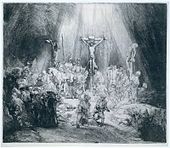
A variant of engraving, done with a sharp signal, rather than a v-shaped burin. While engraved lines are very shine and difficult-edged, drypoint scratching leaves a crude burr at the edges of each line. This burr gives drypoint prints a characteristically soft, and sometimes blurry, line quality. Because the pressure of printing quickly destroys the burr, drypoint is useful only for very small editions; every bit few every bit ten or twenty impressions. To counter this, and allow for longer impress runs, electro-plating (here called steelfacing) has been used since the nineteenth century to harden the surface of a plate.
The technique appears to accept been invented by the Housebook Primary, a south German language fifteenth-century artist, all of whose prints are in drypoint only. Among the most famous artists of the old master print, Albrecht Dürer produced three drypoints before abandoning the technique; Rembrandt used it frequently, merely usually in conjunction with etching and engraving.
Lithography [edit]
Artists using this technique include
Honoré Daumier, Vincent van Gogh, George Bellows, Pierre Bonnard, Edvard Munch, Emil Nolde, Pablo Picasso, Odilon Redon, Henri de Toulouse-Lautrec, Salvador Dalí, M. C. Escher, Willem de Kooning, Joan Miró, Stow Wengenroth, Elaine de Kooning, Louise Nevelson

Lithography is a technique invented in 1798 past Alois Senefelder and based on the chemical repulsion of oil and water. A porous surface, normally limestone, is used; the image is drawn on the limestone with a greasy medium. Acid is applied, transferring the grease-protected design to the limestone, leaving the image 'burned' into the surface. Glue arabic, a water-soluble substance, is and so applied, sealing the surface of the rock not covered with the drawing medium. The stone is wetted, with water staying only on the surface not covered in grease-based rest of the cartoon; the stone is then 'rolled up', meaning oil ink is applied with a roller covering the entire surface; since water repels the oil in the ink, the ink adheres only to the greasy parts, perfectly inking the image. A sheet of dry newspaper is placed on the surface, and the image is transferred to the paper by the pressure of the press press. Lithography is known for its ability to capture fine gradations in shading and very minor particular.
Variations of Lithography [edit]
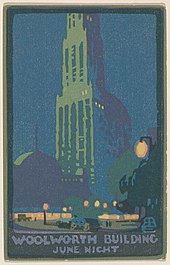
Photo-lithography captures an image by photographic processes on metallic plates; printing is more than or less carried out in the same way equally stone lithography.
Halftone lithography produces an image that illustrates a slope-like quality.
Mokulito is a form of lithography on wood instead of limestone. Information technology was invented past Seishi Ozaku in the 1970s in Japan and was originally called Mokurito.[four]
Screenprinting [edit]
Screen printing (occasionally known as "silkscreen", or "serigraphy") creates prints by using a fabric stencil technique; ink is merely pushed through the stencil against the surface of the newspaper, well-nigh often with the aid of a duster. More often than not, the technique uses a natural or synthetic 'mesh' cloth stretched tightly across a rectangular 'frame,' much like a stretched canvas. The fabric tin can exist silk, nylon monofilament, multifilament polyester, or even stainless steel.[5] While commercial screen press oft requires high-tech, mechanical apparatuses and calibrated materials, printmakers value it for the "Practice It Yourself" approach, and the low technical requirements, high quality results. The essential tools required are a squeegee, a mesh cloth, a frame, and a stencil. Unlike many other printmaking processes, a press press is not required, as screen printing is essentially stencil press.
Screen printing may exist adapted to press on a variety of materials, from newspaper, cloth, and canvas to rubber, glass, and metallic. Artists have used the technique to impress on bottles, on slabs of granite, direct onto walls, and to reproduce images on textiles which would distort under force per unit area from printing presses.
Monotype [edit]
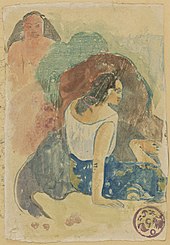

Monotyping is a type of printmaking made by cartoon or painting on a smooth, not-absorptive surface. The surface, or matrix, was historically a copper etching plate, just in contemporary work it can vary from zinc or glass to acrylic drinking glass. The epitome is then transferred onto a canvas of newspaper past pressing the 2 together, ordinarily using a printing-press. Monotypes can also be created by inking an unabridged surface and then, using brushes or rags, removing ink to create a subtractive paradigm, e.thou. creating lights from a field of opaque color. The inks used may be oil based or water based. With oil based inks, the newspaper may be dry out, in which case the epitome has more contrast, or the newspaper may exist clammy, in which case the prototype has a 10 percent greater range of tones.
Unlike monoprinting, monotyping produces a unique print, or monotype, considering virtually of the ink is removed during the initial pressing. Although subsequent reprintings are sometimes possible, they differ profoundly from the kickoff impress and are generally considered junior. A second print from the original plate is chosen a "ghost print" or "cognate". Stencils, watercolor, solvents, brushes, and other tools are ofttimes used to embellish a monotype print. Monotypes are often spontaneously executed and with no preliminary sketch.
Monotypes are the most painterly method among the printmaking techniques, a unique print that is essentially a printed painting. The principal characteristic of this medium is plant in its spontaneity and its combination of printmaking, painting, and cartoon media.[6]
Monoprint [edit]
Monoprinting is a form of printmaking that uses a matrix such every bit a woodblock, litho stone, or copper plate, only produces impressions that are unique. Multiple unique impressions printed from a single matrix are sometimes known every bit a variable edition. At that place are many techniques used in monoprinting, including collagraph, collage, manus-painted additions, and a form of tracing by which thick ink is laid down on a table, newspaper is placed on the ink, and the back of the paper is drawn on, transferring the ink to the paper. Monoprints tin can too exist made by altering the type, color, and viscosity of the ink used to create different prints. Traditional printmaking techniques, such equally lithography, woodcut, and intaglio, can be used to make monoprints.
Mixed-media prints [edit]
Mixed-media prints may apply multiple traditional printmaking processes such every bit etching, woodcut, letterpress, silkscreen, or even monoprinting in the creation of the print. They may besides contain elements of chine colle, collage, or painted areas, and may be unique, i.eastward. ane-off, non-editioned, prints. Mixed-media prints are oftentimes experimental prints and may be printed on unusual, non-traditional surfaces.
Digital prints [edit]
Digital prints refers to images printed using digital printers such every bit inkjet printers instead of a traditional printing press. Images can exist printed to a multifariousness of substrates including paper, cloth, or plastic canvas.
Dye-based inks [edit]
Dye-based inks are organic (not mineral) dissolved and mixed into a liquid. Although about are synthetic, derived from petroleum, they can exist fabricated from vegetable or fauna sources. Dyes are well suited for textiles where the liquid dye penetrates and chemically bonds to the fiber. Because of the deep penetration, more layers of material must lose their colour before the fading is apparent. Dyes, however, are non suitable for the relatively sparse layers of ink laid out on the surface of a print.
Paint-based inks [edit]
Pigment is a finely footing, particulate substance which, when mixed or ground into a liquid to make ink or paint, does not dissolve, but remains dispersed or suspended in the liquid. Pigments are categorized equally either inorganic (mineral) or organic (synthetic).[7] Paint-based inks take a much longer permanence than dye-based inks.[viii]
Giclée [edit]
Giclée (pron.: /ʒiːˈkleɪ/ zhee-KLAY or /dʒiːˈkleɪ/), is a neologism coined in 1991 past printmaker Jack Duganne [9] for digital prints made on inkjet printers. Originally associated with early on dye-based printers it is now more often refers to pigment-based prints.[10] The give-and-take is based on the French discussion gicleur, which ways "nozzle". Today art prints produced on large format ink-jet machines using the CcMmYK color model are generally called "Giclée".
Foil imaging [edit]
In art, foil imaging is a printmaking technique made using the Iowa Foil Printer, developed by Virginia A. Myers from the commercial foil stamping process. This uses gold leaf and acrylic foil in the printmaking process.
Color [edit]

Printmakers utilise color to their prints in many unlike ways. Some coloring techniques include positive surface coil, negative surface gyre, and A la poupée. Often color in printmaking that involves etching, screen printing, woodcut, or linocut is practical past either using separate plates, blocks or screens or by using a reductionist arroyo. In multiple plate color techniques, a number of plates, screens or blocks are produced, each providing a different colour. Each dissever plate, screen, or block will exist inked up in a different colour and practical in a detail sequence to produce the entire motion picture. On boilerplate nigh three to four plates are produced, but at that place are occasions where a printmaker may use upwards to seven plates. Every awarding of another plate of colour will interact with the color already applied to the paper, and this must exist kept in mind when producing the separation of colors. The lightest colors are oft applied first, and then darker colors successively until the darkest.
The reductionist approach to producing color is to start with a lino or forest block that is either blank or with a simple etching. Upon each printing of color the printmaker volition then further cut into the lino or woodblock removing more cloth and and then use another color and reprint. Each successive removal of lino or wood from the block will betrayal the already printed color to the viewer of the print. Picasso is frequently cited as the inventor of reduction printmaking, although at that place is bear witness of this method in utilize 25 years before Picasso'south linocuts.[11]
The subtractive color concept is as well used in kickoff or digital impress and is present in bitmap or vectorial software in CMYK or other color spaces.
Registration [edit]
In printmaking processes requiring more than one awarding of ink or other medium, the problem exists as to how to line upwardly properly areas of an prototype to receive ink in each awarding. The almost obvious example of this would be a multi-color image in which each color is applied in a separate step. The lining upward of the results of each step in a multistep printmaking process is called "registration." Proper registration results in the various components of an prototype being in their proper place. Simply, for creative reasons, improper registration is non necessarily the ruination of an image. Andy Warhol was known to intentionally apply improper registration.
This tin vary considerably from procedure to procedure. It more often than not involves placing the substrate, mostly paper, in right alignment with the printmaking element that will exist supplying it with coloration.[12]
Protective printmaking equipment [edit]
Protective habiliment is very important for printmakers who engage in etching and lithography (airtight toed shoes and long pants). Whereas in the past printmakers put their plates in and out of acrid baths with their bare hands, today printmakers use safe gloves. They as well wearable industrial respirators for protection from caustic vapors. Most acid baths are built with ventilation hoods above them.
Protective respirators and masks should accept particle filters, peculiarly for aquatinting. As a part of the aquatinting process, a printmaker is often exposed to rosin powder. Rosin is a serious health hazard, especially to printmakers who, in the by, simply used to hold their breath[13] using an aquatinting booth.
Print preservation [edit]

Preservation of this 140+ year-quondam print protected under drinking glass required removal of the onetime matting, deacidification of the print, and conservation course new matting.
Modern prints onto paper protected from the sun and moisture will last an incredible long time. Prints made using newer alkaline and acid-complimentary paper have a life expectancy of over one,000 years for the best newspaper and 500 years for average grades. When it comes to older prints, the condition of a print largely depends on the technique used to make the newspaper. Prints that are several hundred years erstwhile may be in better status than prints that are less than fifty years former .[14] Many older prints will yellow or brown over time owing to acids in the paper and any matting or bankroll papers. To preserve/restore older prints, washing, deacidification and treatment with stain reducing agents may be in order.[15] Further, if the impress is framed, archival or conservation grade motion-picture show mats are essential since acids within older or inexpensive matting will assail a print even if the print was produced using acrid-costless paper. Color prints can be susceptible to fading depending on the type of inks used. Lighting of sensitive prints should be limited to 50 lux (5 foot-candles) or less and artificial lights can be equipped with UV-filtering sleeves or tubes.[xvi]
Prints onto animal skins (vellum) should also be maintained at a humidity level between 25% and 40%.[17] Prints onto silk are specially sensitive to any lite including camera flashes.[18]
See likewise [edit]
- Artist's proof
- Banhua, Chinese printmaking
- Carborundum printmaking
- Graphic design
- Line engraving
- List of printmakers
- Former master print
- Shin hanga
- Sosaku hanga
- Ukiyo-e
- Visual arts
Printmakers by nationality [edit]
- Engravers past nationality
- Etchers by nationality
- Printmakers by nationality
References [edit]
- ^ Watton, Jill (2019-04-26). "Japanese Woodblock Printmaking Explained". Jackson's Art Blog . Retrieved 2021-07-24 .
{{cite web}}: CS1 maint: url-condition (link) - ^ Cohen, Brian D. "Freedom and Resistance in the Act of Engraving (or, Why Dürer Gave up on Carving)," Art in Print Vol. vii No. 3 (September–October 2017), 17.
- ^ "Exploding Rosin Box". Directly Dope Bulletin Board. 2010-01-28. Retrieved 2021-07-24 .
- ^ "mokulito - Danielle Creenaune". daniellecreenaune.com . Retrieved 2021-07-24 .
- ^ "Screen Textile". A.Due west.T. World Merchandise Inc.
- ^ Washington printmakers' gallery Archived 2010-12-28 at the Wayback Automobile
- ^ Printmaking FAQ at Magnolia Editions Archived 2009-04-thirteen at the Wayback Motorcar
- ^ Susan Carden, Digital Fabric Printing, Bloomsbury Publishing - 2015, page 27
- ^ Johnson, Harald. Mastering Digital Press, p.11 at Google Books
- ^ Luong, Q.-Tuan. An overview of big format color digital printing at largeformatphotography.info
- ^ "Non Picasso'southward invention - a foray into the history of reductive linoprinting. (2001) by Bunbury, Alisa. · Australian Prints + Printmaking".
- ^ "Nontoxicprint".
- ^ Smidgeon (2014-09-09). "Printmaking 101: Applying Rosin for Aquatint (Using a Rosin Box)". SMIDGEON Printing . Retrieved 2019-07-17 .
- ^ "The Deterioration and Preservation of Paper: Some Essential Facts - Collections Care - Resources (Preservation, Library of Congress)". www.loc.gov . Retrieved 2021-01-03 .
- ^ Marianne (2017-12-sixteen). "Cleaning Stained and Yellowed Works of Fine art On Newspaper". Marianne Kelsey Book and Newspaper Conservator Professional . Retrieved 2021-01-03 .
- ^ "Philadelphia Museum of Art - Research : Conservation". www.philamuseum.org . Retrieved 2021-01-04 .
- ^ Marianne (2020-01-10). "How to Care for Vellum and Parchment Documents". Marianne Kelsey Book and Paper Conservator Professional . Retrieved 2021-01-06 .
- ^ "How practise you preserve a 100-year-former piece of silk and adult female suffrage history?". National Museum of American History. 2013-08-19. Retrieved 2021-01-06 .
Sources [edit]
- What is a Impress?, from the Museum of Modernistic Art
- Bamber Gascoigne: How to Identify Prints: A Complete Guide to Manual and Mechanical Processes from Woodcut to Inkjet (ISBN 0-500-28480-6)
Further reading [edit]
- A. Hyatt Mayor (1971). Prints & people: a social history of printed pictures (full PDF) . New York: The Metropolitan Museum of Art. ISBN9780870991080.
- Beth Grabowski and Nib Fick, "Printmaking: A Consummate Guide to Materials & Processes." Prentice Hall, 2009. ISBN 0-205-66453-9
- Donna Anderson Experience Printmaking. Worcester, MA: Davis Publications, 2009. ISBN 978-0-87192-982-2
- Gill Saunders and Rosie Miles Prints Now: Directions and Definitions Victoria and Albert Museum (May one, 2006) ISBN 1-85177-480-7
- Antony Griffiths, Prints and Printmaking, British Museum Press, 2nd ed, 1996 ISBN 0-7141-2608-X
- Linda Hults The Impress in the Western World: An Introductory History. Madison: University of Wisconsin Press, 1996. ISBN 978-0-299-13700-7
- Ballad Wax, The Mezzotint: History and Technique (Harry N. Abrams, Inc., 1990)
- James Watrous A Century of American Printmaking. Madison: University of Wisconsin Press, 1984. ISBN 0-299-09680-seven
- William Ivins, Jr. Prints and Visual Advice. Cambridge: Harvard Academy Printing, 1953. ISBN 0-262-59002-6
- Donald Saff and Deli Sacilotto. Printmaking: History and Process. New York: Holt, Rinehart, and Winston, 1978. ISBN 978-0030856631
External links [edit]
 | Look up printmaking in Wiktionary, the free dictionary. |
- History of printmaking; glossaries
- Museum of Modern Art, New York: What Is a Print?
- Thompson, Wendy. "The Printed Image in the West: History and Techniques". In Timeline of Fine art History. New York: The Metropolitan Museum of Art, 2000 – . (October 2003)
- André Béguin's dictionary;enormous dictionary of terms, relating more than to the printing than the creation of the image
- Another glossary - for modern prints
- Judging the Authenticity of Prints by The Masters by art historian David Rudd Cycleback
- Printing techniques explained
Printmaking organizations [edit]
- Print Council of America
- International Fine Impress Dealers Clan
- SGC International (formerly Southern Graphics Quango)
- Bellebyrd - The Print Australia blogspot by art historian Josephine Severn.
- Printmaking Creative person: a glossary of contemporary prints
- Iowa Biennial - Exhibition & Archive of Gimmicky Prints
- Site dedicated to the activity of printmaking and thinking creatively. Includes footage of well-known artists working at Crown Point Press in San Francisco.
- Prints and Printmaking: Site devoted to Australian and Pacific printmaking practice and history
Source: https://en.wikipedia.org/wiki/Printmaking
0 Response to "Art Making Encompasses a Variety of Techniques Developed to Create Multiple Copies of a Single Image"
Postar um comentário