U.s. Border Patrol Separating Families Telling Them Their Kids Will Be Bathed
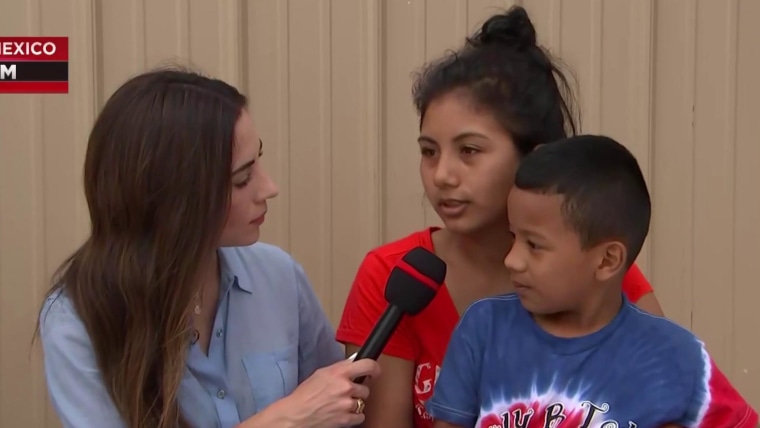
AUSTIN, Texas — Patricia de Jesús Flores waited at a homeless shelter on the Mexican side of the U.S. border this week with her seven-year-old son, who she says witnessed a murder on a rooftop — one reason they left their home in Honduras.
Flores, 27, was trying to decide whether to seek entry into the U.Southward., even though she heard parents who crossed the border illegally were being separated from their children.
She and other families at the Senda de Vida shelter in Reynosa, Mexico, just across from McAllen, Texas, said their communities in El Salvador, Republic of honduras and Republic of guatemala are then racked with violence, and then terrorized by gangs so infiltrated by drug cartels, they had no selection but to get out.
"If my state would be OK, I would exist there happily with my kid," Flores told NBC News. "I would not effort to cross."
While forced family separations — which President Donald Trump on Wednesday announced he would end — was a new manner by the administration of dealing with illegal clearing on the southern border, the violence, drug cartels, gangs and poverty ravaging Central America have been driving people to the United states for years. It remains to be seen how far immigration legislation that Congress is negotiating will get to address those root problems.
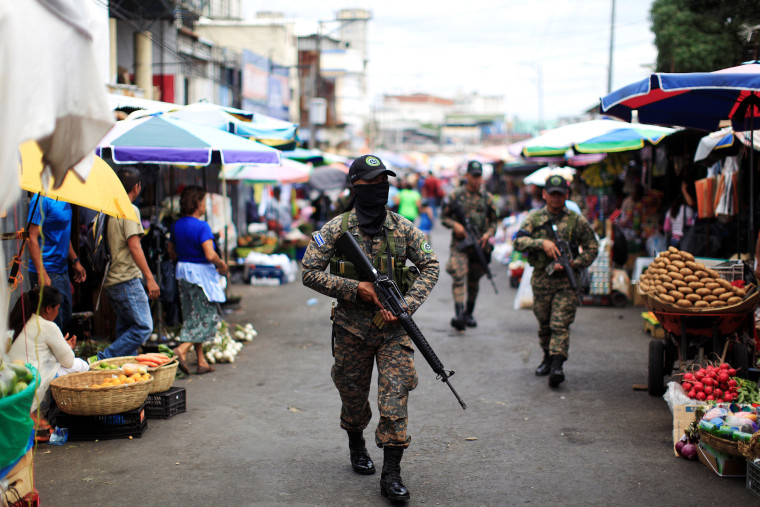
White Firm Main of Staff John Kelly noted the violence in a May 2017 speech at a forum sponsored by the Atlantic Council, a Washington-based foreign policy call up tank.
"There'due south abuse at that place. In that location's terrible intimidation," Kelly said, adding that the cartels "are horrifically fierce and they hold neighborhoods, cities in a grip of fear that includes police force in many cases."
The weather in what is known equally the Northern Triangle of Latin America — El Salvador, Republic of guatemala and Honduras — came to Americans' attending in full forcefulness in 2014, when tens of thousands of children arrived on their own at the U.S. border.
For years, Honduras had the highest homicide rate in the world, peaking at over 91 homicides per 100,000 in 2011, co-ordinate to a Un report. The rate has since declined merely remains comparatively high; final year, the rate was 42.8 homicides per 100,000.
Such violence hasn't stopped residents of the Northern Triangle from making the dangerous trek n to an uncertain welcome on the U.S.-Mexican border. According to the Council on Foreign Relations, some 3.4 meg people born in El salvador, Republic of guatemala and Honduras were living in the United states of america as of 2015, the latest year for which data is available.
The Northern Triangle is domicile to transnational gangs, such as MS-13 and the 18th Street Gang, both founded in Los Angeles, as well as drug cartels and criminal organizations with origins in the area's civil wars.
Corruption, weak and unstable authorities institutions and political turmoil make it difficult for Central American countries to gainsay the gangs and violence. Early this year in Honduras, protests post-obit the re-election of President Juan Orlando Hernandez turned vehement when police and troops used excessive forcefulness to quell protests, leaving 32 expressionless. No police force or troops were charged, Amnesty International said in a study, The Associated Press reported.
"Based on our interviews with individuals in immigration detention and at the border about the conditions they are fleeing … the atmospheric condition haven't changed, which is why we are seeing these large numbers of people arriving," said Alison Parker, managing director of the Human Rights Watch'due south U.S. Programme.
Border Patrol apprehensions on the southern border and so far this fiscal year, which began in October, full 252,187. That's an increase of most 230,000 over the offset eight months of 2017, when apprehensions totaled 224,817, according to Customs and Border Patrol statistics.
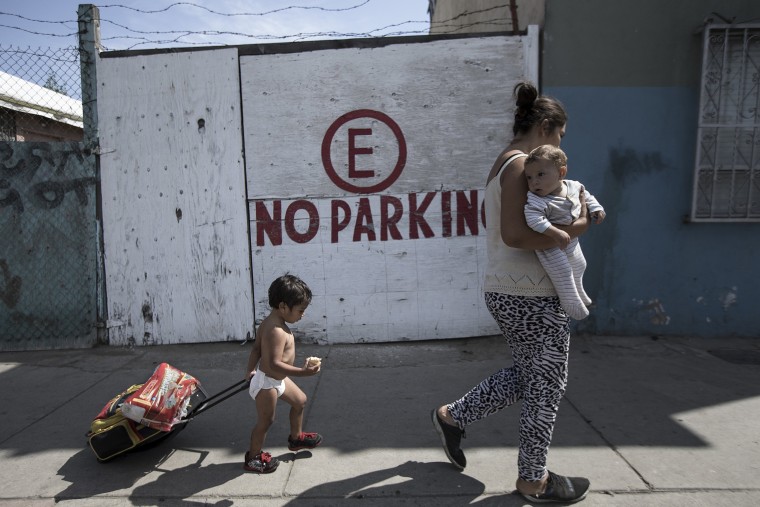
The unrelenting turmoil of the region appears to still be driving families to flee with their children.
Piedad De Jesús Mejía, a 31-year-onetime mother from Honduras, had traveled to Reynosa, Mexico, with her four children. She said Tuesday that she had heard about the family unit separations going on at the border, but "I had to go out without caring most that."
"I left my land because of the crimes and because we were witnesses when two of my husband's cousins were killed and now they are looking for the states, also," she said.
In Matamoras, Mexico, Jennifer Figueroa from Republic of honduras held her 3-year-quondam son, Affections, every bit she stood on an international bridge leading into Brownsville, Texas.
She had been in United mexican states three days hoping to cross into the United States legally and enquire for asylum. She said she had left her country because of death threats from the 18th Street gang and had paid a smuggler about $125 to get to the U.South.

Told of the separations happening at the border, she insisted she would not permit her son get. "I'd rather ask them to behave me," Jennifer said.
To bargain with the 2014 surge in Cardinal American families and children arriving at the edge, the Obama assistants and Congress adopted a broad U.Due south. strategy to address not only what was happening at the border, only too the abuse and violence of the region, experts said.
The U.S. upped its investment in the region substantially, although not to the extent or as quickly equally Obama had wanted. He had asked for a $i billion investment at the time.
"It took eighteen months to convince Congress to put $750 1000000 bucks" toward addressing the issues, said Cecilia Muñoz, who served as Obama's managing director of the White Firm Domestic Policy Council. In 2014, the total was about $317 million.
The administration also created "in-country" programs for adults and to some degree children to apply for asylum from their countries. It called on other countries in the region to "step up" and accept people applying for asylum.
"All of those were policies that were developing, and, of course, they've all been dismantled by this assistants," Muñoz said.
Although the Trump administration continues to piece of work with the Northern Triangle countries — Vice President Mike Pence is to visit victims of contempo volcanoes in Guatemala next week and met with the Honduran president Midweek —the region'south problems are "so deep and so endemic they cannot be fixed in a couple years," said Jason Marczak, manager of the Atlantic Council's Adrienne Arsht Latin America Eye.
"People will come up either way because they are trying to survive," Marczak said.
During the 2014 crisis, United mexican states took a more active role, working to clamp down on illegal immigration through its southern border. Last year, Mexico coordinated with the Trump administration to organize a conference in Miami on what could be washed to push button for systemic change in Central America.
Simply the family separations have produced images and stories that have shocked other parts of the world and are harming the image of the U.S. The controversy could slow efforts to bring well-nigh lasting change in the Northern Triangle.
"Unfortunately the focus is instead on deterrence on the border," Marczak said. "The focus needs to exist on how to improve conditions in the countries so people don't exit in the first identify."
Suzanne Gamboa reported from Austin, Mariana Atencio from Reynosa, Mexico, and Gabe Gutierrez from Matamoros, Mexico.
Follow NBC News Latino on Facebook, Twitter and Instagram.
Source: https://www.nbcnews.com/storyline/immigration-border-crisis/central-america-s-violence-turmoil-keeps-driving-families-u-s-n884956
0 Response to "U.s. Border Patrol Separating Families Telling Them Their Kids Will Be Bathed"
Postar um comentário